
 Overview
 Overview
The rectum is part of the body’s digestive system. The digestive system removes and processes nutrients, vitamins, minerals, carbohydrates, fats, proteins, and water from foods and helps pass waste material out of the body. The digestive system is made up of the esophagus, stomach and the small and large intestines. The first 6 feet of the large intestine are called the large bowel or colon. The last 6 inches are the rectum and the anal canal. The anal canal ends at the anus, the opening of the large intestine to the outside of the body.
Risk factors
Age 50 years or above.
A family history of cancer of the colon or rectum
A personal history of cancer of the colon, rectum, ovary, endometrium or breast.
A history of ulcerative colitis (Ulcers in the lining of the large intestine or crohn’s disease.)
Certain hereditary conditions such as familial adenomatous polyposis and hereditary non-polyposis colon cancers.
Signs and symptoms
A change in bowel habits
Blood (either bright red or very dark) in the stool
Diarrhea, constipation, or feeling that the bowel does not empty completely
Stools that are narrower than usual
General abdominal discomforts, frequent gas, pains, bloating, fullness, or cramps.
Weight loss with no known reasons
Constant tiredness
Vomiting
Diagnosis as per modern science
Fecal occult test
Digital rectal exam
Barium enema
Sigmoidoscopy
Colonoscopy
Biopsy
Staging
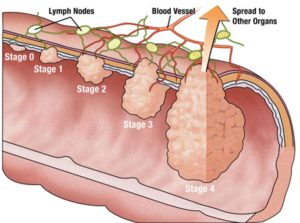
Stage 0 – A very early cancer involving only the innermost lining of the colorectum
Stage I – The cancer involves a little more of the inner wall of the colorectum
Stage II – The cancer has spread outside the rectum to nearby tissue, but it has not gone into the lymph nodes (small, bean-shaped structures found throughout the body that filter substances in a fluid called lymph and help fight infection and disease).
Stage III – In stage III, cancer has spread to nearby lymph nodes, but it has not spread to other parts of the body
Stage IV – In stage IV, cancer has spread to other parts of the body, such as the liver, lungs, or ovaries.